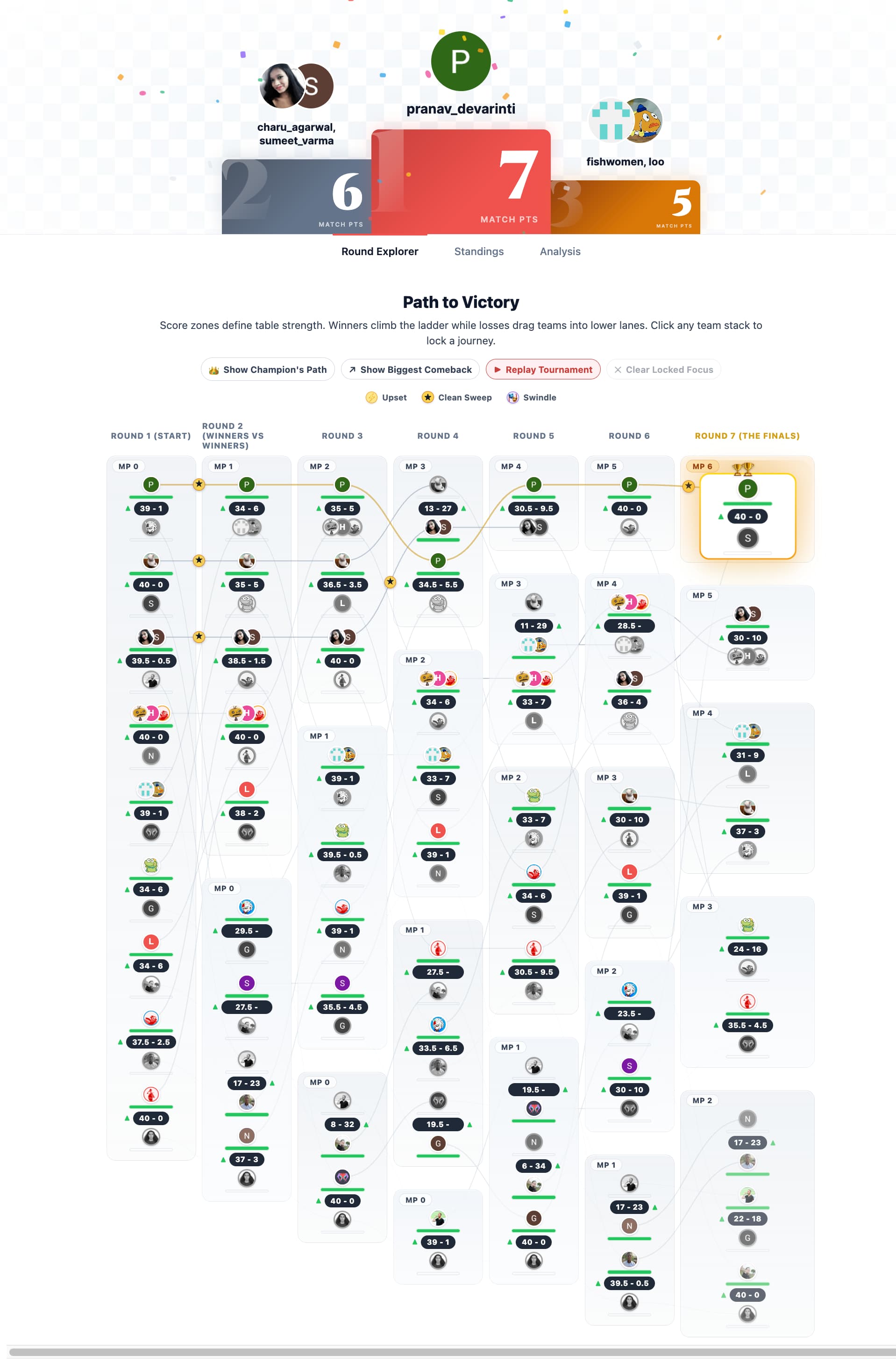
To determine the final ranking of qualifying agents in the Global Chess Challenge, we ran a structured Swiss-system tournament. This post describes the tournament format, including the pairing system, scoring rules, tie-break criteria, and reporting methodology.
Qualification and Pairing
All agents meeting the published qualification criteria (see the main challenge evaluation rules) entered a single Swiss-system tournament pool.
We used a Swiss-system format, meaning:
- All agents play the same number of rounds (including byes, if assigned).
- After each round, standings are updated based on cumulative Match Points (MP).
- In subsequent rounds, agents are paired against opponents with similar cumulative match points.
- Repeat pairings are avoided whenever feasible, subject to standard Swiss pairing constraints.
Let (N) denote the number of participating agents. The number of rounds (R) was defined as:

Match Structure and Evaluation
Each pairing within a round consisted of a 40-game mini-match.
We selected 40 games to reduce variance in estimated relative strength. Short matches can be highly sensitive to stochastic fluctuations; increasing the number of games reduces short-term randomness in outcomes.
The mini-match protocol enforced the following controls:
- Colors alternated deterministically.
- Each agent played exactly 20 games as White and 20 as Black.
- Each game was capped at 200 moves.
- Each move had to be produced within 30 seconds. If an agent timed out, the move is retried up to two additional times (3 attempts total). If all three attempts exceed the time limit, the game is declared a resignation.
These constraints ensure symmetry across color assignments, standardize computational conditions, and bound total evaluation cost.
Game and Match Scoring
Each individual game used standard chess scoring:
- Win = 1
- Draw = 0.5
- Loss = 0
For a given mini-match, Game Points (GP) are defined as the sum of these game-level scores across the 40 games.
The mini-match outcome is then mapped to Match Points (MP) as follows:
- Match win → 1 MP
- Match draw → 0.5 MP
- Match loss → 0 MP
Match Points are the primary ranking variable in the Swiss standings.
If a round contains an odd number of agents, exactly one agent receives a bye. Bye assignment follows a fixed priority rule: preference is given to agents who have not previously received a bye; among those, the agent with the lowest current Match Points is selected; if still tied, the agent with the numerically higher previous round standing (i.e., the lower-performing position on the previous round leaderboard) is selected; if still tied, the agent with the earlier submission timestamp is selected (i.e., earlier submitted entries are preferred). A bye is scored as 0.5 Match Points and 1 Game Point.
What the Leaderboard Shows
The tournament leaderboard reports (i) primary ranking variables, (ii) ordered tie-break metrics, and (iii) auxiliary diagnostic statistics. The columns displayed on the leaderboard correspond exactly to the quantities defined below.
Primary Ranking Variable
- Match Points (MP) — cumulative mini-match outcomes (match win = 1, draw = 0.5, loss = 0; bye = 1). Final standings are ordered by MP.
Tie-Break Scores
(in the following order - each applied only if the previous criterion does not break the tie)
- Head-to-Head Score (H2H) — total game points scored in matches among tied agents.
- Buchholz Score — sum of the Match Points of all opponents faced. Higher scores indicate the agent competed against stronger opponents.
- Sonneborn–Berger Score (SB) — weighted score rewarding wins against stronger opponents more heavily.
Additional Reported Statistics
- Game Points (GP) — cumulative individual game scores aggregated across all mini-matches in the tournament (win = 1, draw = 0.5; bye = 2).
- ACPL (Average Centipawn Loss) — mean per-move centipawn loss across all tournament games
- Win Rate (%) — (total wins / total games played) × 100.
Match Points determine ordinal ranking. The tie-break metrics (H2H, Buchholz, SB) resolve equal MP scores in the specified order. Game Points, Win Rate, and ACPL provide additional transparency into game-level performance and move quality.
How Tie-Breaks Are Applied
If two or more agents finish with equal Match Points, ties are resolved using the Tie-Break Scores as defined above, applied in strict lexicographic order:
- Head-to-Head Score (H2H)
- Buchholz Score
- Sonneborn–Berger Score (SB)
Buchholz and Sonneborn–Berger are standard tie-break mechanisms in competitive chess tournaments and explicitly incorporate opponent strength into the final ranking.
For transparency, we provide per-game results, downloadable PGNs and summary statistics. The final standings from this tournament determine the winners of this challenge.
The final Swiss standings computed under this protocol determine the official winners of this iteration of the challenge.
We warmly congratulate the winning teams for their outstanding performance. We are grateful to all participants for the depth of experimentation and iteration demonstrated throughout the challenge.