see this:
● Phase 2 verdict on your forum question, from the mini 100 + the graded LB mean: the “unusually easy leaderboard set” effect is gone — and more
interestingly, the tail itself is gone.
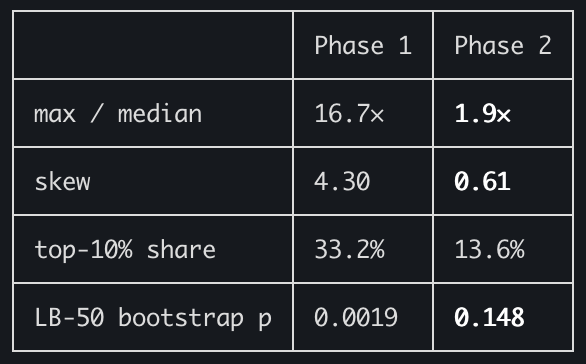
Results (cov-prop per-MLP final MSE, official N=1e9 truth)
┌───────────────────┬─────────┬─────────┐
│ │ Phase 1 │ Phase 2 │
├───────────────────┼─────────┼─────────┤
│ max / median │ 28.3× │ 1.4× │
├───────────────────┼─────────┼─────────┤
│ skew │ 7.74 │ 0.03 │
├───────────────────┼─────────┼─────────┤
│ top-10% share │ 40.0% │ 13.3% │
├───────────────────┼─────────┼─────────┤
│ LB-50 bootstrap p │ 0.0019 │ 0.139 │
└───────────────────┴─────────┴─────────┘
Concretely: LB-50 graded mean is 3.933e-6, and 50-MLP bootstrap draws from the public mini give [3.84e-6, 4.26e-6] at 95% — the leaderboard
value sits at the 13.9th percentile, i.e. slightly lucky but statistically unremarkable. Same story for sampling error (mub per-MLP max/med
1.6× vs phase-1’s 28×).
Interpretation
The phase-1 easiness gap wasn’t primarily a filtering story — it was a depth story. 32 layers compound variance into a heavy-tailed per-MLP
difficulty distribution, and any truth-certifiability filter then bites hard on that tail. At 16 layers the difficulty distribution is nearly
symmetric with no tail, so there’s essentially nothing to truncate: public and leaderboard sets look alike, and local scores should transfer
to the leaderboard almost 1:1 (as ours just did, to 8 digits). jamesrahenry’s phase-1 concern — “the LB can’t test the hard-to-verify MLPs” —
is largely moot at this shape.